All published articles of this journal are available on ScienceDirect.

Home-based Rhythmic Auditory Stimulation for Motor Function and Ambulation in Subacute Stroke: A Quasi-Experimental Pilot Study
 Sherly Yakobus1
Christiana Rialine Titaley1
Sherly Yakobus1
Christiana Rialine Titaley1
Authors Info & Affiliations
Abstract
Introduction/Objective
Stroke causes a high burden of motor and functional disability. Rhythmic Auditory Stimulation (RAS) demonstrates potential in enhancing motor recovery and ambulation, particularly given the pronounced sociocultural affinity of the Ambonese population for rhythmic elements. This study evaluated the effect of RAS therapy using the Ronnie Gardiner Method (RGM) on walking ability and motor function in subacute stroke patients.
Methods
This quasi-experimental study involved 30 subacute stroke patients at a referral hospital in Ambon, Indonesia. Participants were allocated into a control group (n=15) and an intervention group (n=15). The intervention group received home-based RGM therapy for one month, while the control group received standard care. Outcomes were measured using the Functional Ambulation Category (FAC) for walking ability and Manual Muscle Testing (MMT) for motor function. Data were analyzed utilizing Chi-square, Fisher's Exact, and binary logistic regression tests.
Results
No statistically significant difference in FAC scores was observed between the two groups (p = 0.136). However, the intervention group demonstrated a highly significant improvement in extremity motor function compared to the control group (p = 0.035).
Discussion
Multivariate analysis confirmed that the music intervention independently predicted motor improvement (aOR = 11.56). Furthermore, achieving a functional motor status emerged as the strongest predictor for attaining walking independence (aOR = 23.64).
Conclusion
RAS therapy utilizing the RGM significantly improves motor function, which serves as a crucial foundational mechanism for walking independence, although it did not directly translate to functional ambulation within the one-month intervention period. RGM shows potential as a supportive adjuvant approach in home-care rehabilitation, though further validation in larger trials is warranted.
1. INTRODUCTION
Stroke remains a leading cause of global neurological morbidity, resulting in millions of deaths annually and leaving approximately 18% of patients with severe, long-term disabilities [1, 2]. In Indonesia, the prevalence and catastrophic financial burden of stroke continue to escalate [3, 4], with the country recording the highest mortality and Disability-Adjusted Life Years (DALYs) rates in Southeast Asia [5, 6]. This localized burden is significantly evident in Maluku Province, where the years of life lost substantially exceed the national average, and the prevalence increased to 9.0 per mille in 2018 [7-9]. Preliminary data from a referral hospital in Ambon recorded 276 stroke cases between January and October 2024 alone, emphasizing the urgent need for effective, evidence-based rehabilitation strategies to mitigate this severe decline in patients' quality of life.
Optimal neurorehabilitation requires a coordinated, multidisciplinary approach [10]. Combining standard physiotherapy with Rhythmic Auditory Stimulation (RAS) has been proven to significantly improve motor recovery, coordination, and neuroplasticity, particularly when initiated during the acute and early subacute phases [11-13]. A highly applicable music-based RAS intervention is the Ronnie Gardiner Method (RGM), which integrates cognitive-motor dual-task training with social interaction in a cost-effective manner without adverse effects [14, 15]. Previous research indicates that conventional physiotherapy combined with RGM significantly enhances walking independence in stroke patients, as measured by the Functional Ambulation Category [14].
The designation of Ambon as a UNESCO City of Music in 2019 presents a unique cultural paradigm for localized healthcare development [16]. The local population possesses a deep-rooted sociocultural affinity and an intuitive responsiveness to rhythmic elements [17]. This cultural familiarity substantially enhanced the patients' emotional acceptance, motivation, and adherence during home-based sessions, thereby facilitating active engagement and supporting the observed motor improvements. Such high musical familiarity is hypothesized to optimize the rhythmic synchronization between auditory stimuli and motor execution, ultimately enhancing functional ambulation [14]. Despite this immense potential, evidence-based music therapy remains underutilized in Ambon’s clinical settings. Aligning with the “Music for Healing” vision initiated by the Ambon Music Office [18], this study aimed to evaluate the effect of RAS therapy using the RGM on the walking ability and motor function of subacute stroke patients in Ambon.
2. METHODS
This study utilized a quasi-experimental design with a pretest-posttest control group approach. The research was conducted at a referral hospital in Ambon, Indonesia, from May to October 2025. Sampling was performed using purposive sampling with an initial target of 32 subjects (16 subjects per group). A formal a priori sample size calculation was conducted using the Federer formula for experimental studies, defined as (n - 1)(t - 1) ≥ 15, where t represents the number of groups (t = 2). The calculation indicated a minimum requirement of 16 subjects per group. Consequently, 32 subjects were initially enrolled. Due to two unrelated dropouts, the final analyzed sample consisted of 15 subjects per group. Inclusion criteria comprised adult patients (>18 years) diagnosed with a first-time stroke (ischemic or hemorrhagic) within the last two months (early subacute phase), possessing moderate to moderately severe disability (Modified Rankin Scale [mRS] score of 3–4), and having normal cognitive function (MoCA-Ina score > 26). Patients were excluded if they could walk fully independently (Functional Ambulation Category [FAC] 5), had concomitant musculoskeletal or neurological comorbidities, or experienced communication (aphasia), visual field, or hearing impairments that could hinder the intervention.
The subjects were divided into two groups. The control group received standard care over a one-month observation period, which consisted of pharmacotherapy, routine physiotherapy, or a combination of both, strictly tailored to the patient's specific medical indications. Pharmacotherapy was managed by a neurologist during weekly visits to the neurology outpatient clinic. Routine physiotherapy was conducted one to two times per week at the medical rehabilitation clinic, with the schedule, session duration, and exercise programs individually determined by a Physical Medicine and Rehabilitation specialist. The intervention group received standard care combined with Rhythmic Auditory Stimulation (RAS) using the Ronnie Gardiner Method (RGM). The RGM intervention was delivered in a home care setting for one month, with a target frequency of twice a week. Each session lasted 90 minutes, consisting of 15 minutes of preparation, 60 minutes of core training featuring a progressively increasing dual-task complexity, involving synchronized rhythmic hand and foot tapping while simultaneously processing visual symbols presented via a laminated paper booklet in a flip-calendar format, explicitly guided by a distinct auditory rhythmic cue, and 15 minutes of cooling down. The primary outcome was walking ability, measured using the FAC instrument by neurologists and/or medical rehabilitation specialists before (pre-test) and after (post-test) the intervention. For statistical analysis, FAC scores were recategorized into Non-walkers (FAC 0–2) and Walkers (FAC 3–5). Additionally, extremity motor function status was evaluated using Manual Muscle Testing (MMT) on a 0–5 scale, which was subsequently categorized into non-functional motor (total score 10–14) and functional motor (total score 15–20).
Data analysis was performed using IBM SPSS Statistics software. Bivariate analysis utilized Chi-square and Fisher’s Exact tests, while multivariate analysis employed binary logistic regression. During the study period, there were two cases of mortality unrelated to the intervention (unrelated deaths). Consequently, data processing applied the Modified Intention to Treat (mITT) principle by excluding these two patients, resulting in a final analyzed sample size of 30 subjects. This study obtained ethical approval from the Ethics Committee of the Faculty of Medicine, Pattimura University (Number: No.028/FK-KOM.ETIK/IV/2025), and all subjects or their legal guardians provided written informed consent before being included in the study.
3. RESULTS
This study initially assessed 39 patients for eligibility. Thirty-two subjects met the inclusion and exclusion criteria and were enrolled in the study. During the intervention period, two patients dropped out due to unrelated deaths. The final analysis included 30 subjects, divided equally into a control group (n=15) and an intervention group (n=15) (Fig. 1). The majority of the subjects were female (63.3%) with a mean age of 61 ± 7.9 years. Clinical characteristics were dominated by ischemic stroke (86.7%) with a moderate severity of disability or mRS 3 (60.0%). Bivariate analysis of baseline data indicated no statistically significant differences between the control and intervention groups regarding age, gender, stroke type, severity, history of physiotherapy, or initial FAC and motor function scores (all p > 0.05). This indicates that the two groups were equivalent and homogeneous before the intervention commenced (Table 1).
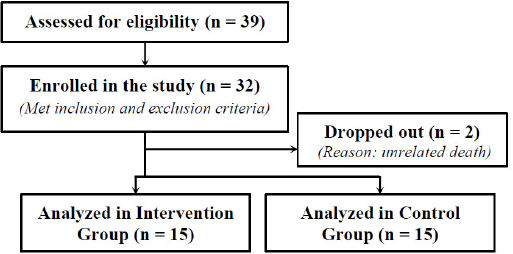
Participant flow diagram illustrating the recruitment, enrollment, attrition, and final analysis of the study.
| Characteristics | n | % | Mean ± SD | Min-Max | p-value* |
|---|---|---|---|---|---|
| Age (years) | - | - | - | - | - |
| Overall | 30 | 100 | 61 ± 7.9 | 44-77 | 0.309 |
| Adult | 1 | 3.3 | - | - | - |
| Pre-elderly | 10 | 33.3 | - | - | - |
| Elderly | 19 | 63.3 | - | - | - |
| Gender | - | - | - | - | 0.058 |
| Female | 19 | 63.3 | - | - | - |
| Male | 11 | 36.7 | - | - | - |
| Stroke type | - | - | - | - | 0.598 |
| Ischemic stroke | 26 | 86.7 | - | - | - |
| Hemorrhagic stroke | 4 | 13.3 | - | - | - |
| Severity level (mRS) | - | - | - | - | 0.136 |
| mRS 3 (moderate) | 18 | 60 | - | - | - |
| mRS 4 (moderately severe) | 12 | 40 | - | - | - |
| Pre-test FAC | - | - | - | - | 0.464 |
| FAC 0 | 11 | 36.7 | - | - | - |
| FAC 1 | 1 | 3.3 | - | - | - |
| FAC 2 | 2 | 6.7 | - | - | - |
| FAC 3 | 5 | 16.7 | - | - | - |
| FAC 4 | 11 | 36.7 | - | - | - |
| Pre-test motor function | - | - | - | - | 0.109 |
| Score 10 | 3 | 10 | - | - | - |
| Score 12 | 2 | 10 | - | - | - |
| Score 13 | 1 | 3.3 | - | - | - |
| Score 14 | 3 | 6.7 | - | - | - |
| Score 16 | 5 | 16.7 | - | - | - |
| Score 17 | 2 | 6.7 | - | - | - |
| Score 18 | 14 | 46.7 | - | - | - |
| Physiotherapy | - | - | - | - | 0.256 |
| Yes | 11 | 36.7 | - | - | - |
| No | 19 | 63.3 | - | - | - |
Note: *Chi-square test or Fisher’s Exact test if there is a cell expectation value < 5.
Description: mRS (modified rankin scale), FAC (Functional Ambulation Category).
Evaluation of the primary outcome (Fig. 2a), walking ability (Functional Ambulation Category/FAC), revealed an increase in the proportion of subjects in the walkers category within the intervention group to 73.3%, compared to 46.7% in the control group. Although there was an observable clinical improvement, statistical testing demonstrated that this difference was not significant (p = 0.136). Conversely, evaluation of the secondary outcome showed different results (Fig. 2b). The proportion of subjects with functional motor status increased drastically to 93.3% in the intervention group, compared to 53.3% in the control group, and this difference in motor function achievement was statistically significant (p = 0.035).
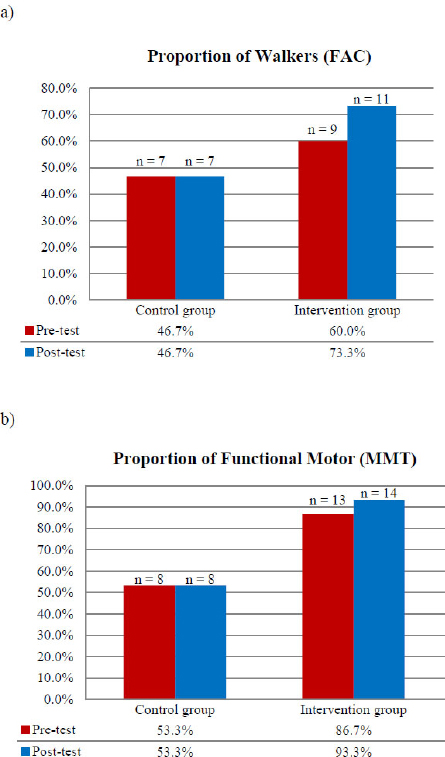
Comparison of clinical outcomes before and after intervention. (a) Proportion of patients achieving independent walking status (Walkers) based on the Functional Ambulation Category (FAC). (b) Proportion of patients achieving functional extremity motor status based on Manual Muscle Testing (MMT).
Abbreviations: FAC (Functional Ambulation Category), MMT (Manual Muscle Testing).
Multivariate binary logistic regression analysis was conducted to evaluate predictors of functional outcomes (Table 2). The RGM music therapy intervention was shown to independently predict improvements in motor function (p = 0.036; aOR 11.56; 95% CI: 1.17–113.81). Furthermore, regression modeling on walking ability indicated that motor function status was the strongest predictor for patients to achieve the walkers category (p = 0.015; aOR 23.64; 95% CI: 1.86–300.28). However, the intervention group variable itself was not shown to directly predict the FAC outcome within the one-month duration of this study (p = 0.935).
| Dependent Variable | Independent Predictors | p-value | aOR |
95% CI (Lower - Upper) |
|---|---|---|---|---|
| Walking Ability (FAC) | Group | 0.935 | 1.09 | 0.15 - 7.89 |
| Motor Function | 0.015* | 23.64 | 1.86 - 300.28 | |
| Physiotherapy | 0.839 | 0.82 | 0.13 - 5.40 | |
| Motor Function (MMT) | Group | 0.036* | 11.56 | 1.17 - 113.81 |
| Physiotherapy | 0.735 | 1.42 | 0.19 - 10.78 |
Note: *Statistically significant (p<0.05).
Description: aOR (odds ratio), CI (confidence interval).
4. DISCUSSION
This study evaluated the effect of Rhythmic Auditory Stimulation (RAS) therapy using the Ronnie Gardiner Method (RGM) on the walking ability and extremity motor function of subacute stroke patients. Overall, the findings illustrate the dynamics of recovery during the subacute phase, demonstrating variable impacts depending on the evaluated outcome. While functional walking ability did not show a statistically significant improvement, basic extremity motor function exhibited significant recovery.
Regarding the primary outcome, the increased proportion of patients achieving the 'walkers' category in the intervention group lacked statistical significance compared to the control group (p = 0.136). This finding diverges from previous literature reporting the efficacy of music therapy on functional ambulation [14]. This discrepancy is primarily attributed to unpredictable patient schedules, which present a major challenge in home-care rehabilitation settings. Due to the rigid alignment with the predetermined one-month study timeframe, the total accumulation of training sessions per patient varied widely, ranging from 0 to 6 sessions. Scheduling adjustments were strictly required to avoid conflict with routine outpatient clinic follow-ups and conventional physiotherapy sessions, as overlapping appointments would induce severe patient fatigue. Additionally, unforeseen events beyond the investigator’s control frequently led to session cancellations. Consequently, the rhythmic stimulation failed to reach the intensive repetition threshold, the necessary therapeutic “dose” required to trigger neuroplasticity for complex motor tasks such as independent ambulation.
Despite a lack of significant improvement in complex functional outcomes, the RAS intervention resulted in a highly significant improvement in extremity motor function (p = 0.035). This success at the foundational impairment level aligns with the recovery mechanism of auditory-motor entrainment. While our study evaluated clinical parameters using Manual Muscle Testing (MMT) and the Functional Ambulation Category (FAC), prior neurophysiological literature suggests that predictable rhythmic stimulation acts as an external anticipatory timing cue that optimally primes the sensorimotor networks [19]. This auditory-motor coupling is hypothesized to facilitate neural entrainment, particularly within the beta oscillatory band, which is crucial for movement planning, synchronization, and motor execution [19]. Furthermore, RGM integrates cognitive-motor dual-task training and active social interaction [18]. Such engaging musical intervention could potentially modulate the mesencephalon-striatal dopaminergic system, which is suggested to play a role in reward-based learning, motivated behavior, and affective regulation [19]. We hypothesize that this rhythmic-induced dopaminergic activation might help maximize the patients' motor output during the supervised sessions, partially compensating for the low training frequency.
When interpreting these functional improvements, the interplay between statistical baseline comparability and observable clinical baseline imbalances must be considered. Although initial statistical testing indicated no significant differences between the groups at baseline (p > 0.05), clinical observation of the pre-intervention data revealed a baseline imbalance, with 86.7% of the intervention group already presenting with functional motor status compared to 53.3% in the control group. Despite this narrow margin for improvement, the rhythmic auditory intervention successfully optimized the remaining functional capacity, bringing the functional proportion to 93.3%. This suggests that RGM may serve as a helpful adjunctive approach to support motor recovery, even in patients who already possess a relatively high baseline functional status.
Socio-cultural factors also contextualize the success of this intervention at the basic motor level. Conducted in Ambon, a region with a strong cultural identity as a UNESCO City of Music, the study successfully leveraged the local population's deep-rooted sociocultural affinity and intuitive responsiveness to rhythmic elements [17]. This cultural familiarity substantially enhanced emotional acceptance, intrinsic motivation, and adherence during the active sessions, thereby optimizing the therapeutic effects of the auditory stimulus.
The hypothesis regarding a step-wise recovery pattern was robustly supported by the multivariate logistic regression analysis. The RGM intervention independently predicted basic motor improvement (aOR = 11.56). Subsequently, modeling for walking ability indicated that a functional motor status is a strong predictor for achieving walking independence (aOR = 23.64). These findings suggest an indirect mechanistic effect: the motor strength improvement facilitated by music serves as a critical, facilitative foundation that must be established before higher-order levels of functional ambulation can be fully achieved.
5. STUDY LIMITATIONS
Several limitations in this study must be carefully acknowledged. First, the relatively small sample size (n=30) and the exploratory nature of this study limit the generalizability of the findings and resulted in wide confidence intervals within the multivariate regression analysis. Consequently, the specific effect estimates should be interpreted with caution, and this research is best viewed as a pilot study. Second, the logistical constraints inherent in a home-care setting led to considerable variability in intervention adherence, with training sessions fluctuating between 0 and 6 sessions per patient. This variable training intensity restricted our ability to ensure the optimal therapeutic dose required to achieve significant improvements in more complex higher-order functions, such as walking independence. Third, while formal statistical tests confirmed baseline comparability (p > 0.05), the small sample size (n=30) inherently lacked the statistical power to detect the observable clinical baseline imbalances. The notably higher proportion of favorable functional status in the intervention group at the pre-test narrowed the potential margin for observable post-intervention improvements. Furthermore, executing multivariate logistic regression analysis on such a small sample size inherently yields unstable estimates. This substantial statistical constraint emphasizes why the predictive values and specific effect estimates must be interpreted with strict caution.
CONCLUSION
In conclusion, this exploratory pilot study indicates that home-based Rhythmic Auditory Stimulation (RAS) therapy using the Ronnie Gardiner Method (RGM) in subacute stroke patients did not directly translate to a statistically significant improvement in functional walking ability within a one-month period. However, the preliminary findings suggest that this intervention could support extremity motor function, which may serve as a facilitative foundation for walking independence. Given the small sample size, RGM should be cautiously considered as a potential adjuvant approach in home-care rehabilitation. Future large-scale randomized controlled trials with larger sample sizes and more consistent training frequencies are required to validate these preliminary observations and establish definitive clinical effectiveness.
AUTHORS’ CONTRIBUTIONS
The authors confirm contribution to the paper as follows: S.J.M.T., L.B.S.H., S.Y.: Contributed to the conceptualization; S.J.M.T. and L.B.S.H.: Contributed to data collection; S.J.M.T. and C.R.T.: Contributed to data curation and study methodology; S.J.M.T.: Performed the formal analysis and prepared the original draft of the manuscript; C.R.T.: Contributed to data analysis; S.J.M.T., L.B.S.H., S.Y., and C.R.T.: Reviewed and edited the final manuscript. All authors have read and approved the final manuscript.
LIST OF ABBREVIATIONS
| aOR | = Adjusted Odds Ratio |
| DALYs | = Disability-Adjusted Life Years |
| FAC | = Functional Ambulation Category |
| mITT | = Modified Intention To Treat |
| MMT | = Manual Muscle Testing |
| mRS | = Modified Rankin Scale |
| RAS | = Rhythmic Auditory Stimulation |
| RGM | = Ronnie Gardiner Method |
ETHICS APPROVAL AND CONSENT TO PARTICIPATE
This study obtained ethical approval from the Ethics Committee of the Faculty of Medicine, Universitas Pattimura, Ambon, Indonesia, with the approval reference number: No.028/FK-KOM.ETIK/IV/ 2025.
HUMAN AND ANIMAL RIGHTS
All human research procedures followed were in accordance with the ethical standards of the committee responsible for human experimentation (institutional and national), and with the Helsinki Declaration of 1975, as revised in 2013.
CONSENT FOR PUBLICATION
Written informed consent was obtained from all participants or their legal guardians prior to enrollment in the study.
AVAILABILITY OF DATA AND MATERIALS
The data supporting the findings of this article are available from the corresponding author [L.B.S.H.] upon reasonable request.
ACKNOWLEDGEMENTS
The authors would like to express their deepest gratitude to Elpira Asmin, S.KM., M.Kes, as the academic advisor, and the examiners: Parningotan Y. Silalahi, Sp.S., FINA, ALH, Anggun L. Husein, M.Biomed, and Bertha J. Que, Sp.S., M.Kes, for their invaluable guidance, constructive feedback, and constant motivation throughout the academic journey and the preparation of this manuscript. Furthermore, the authors thank the Director and staff of the referral hospital in Ambon for facilitating this research. Special thanks are extended to all the patients and their families who participated in this study.